AI Expertise for Complex Systems
Generative AI is incredibly useful when bounded by explicit constraints and governed with the same rigor we apply to any other complex system.
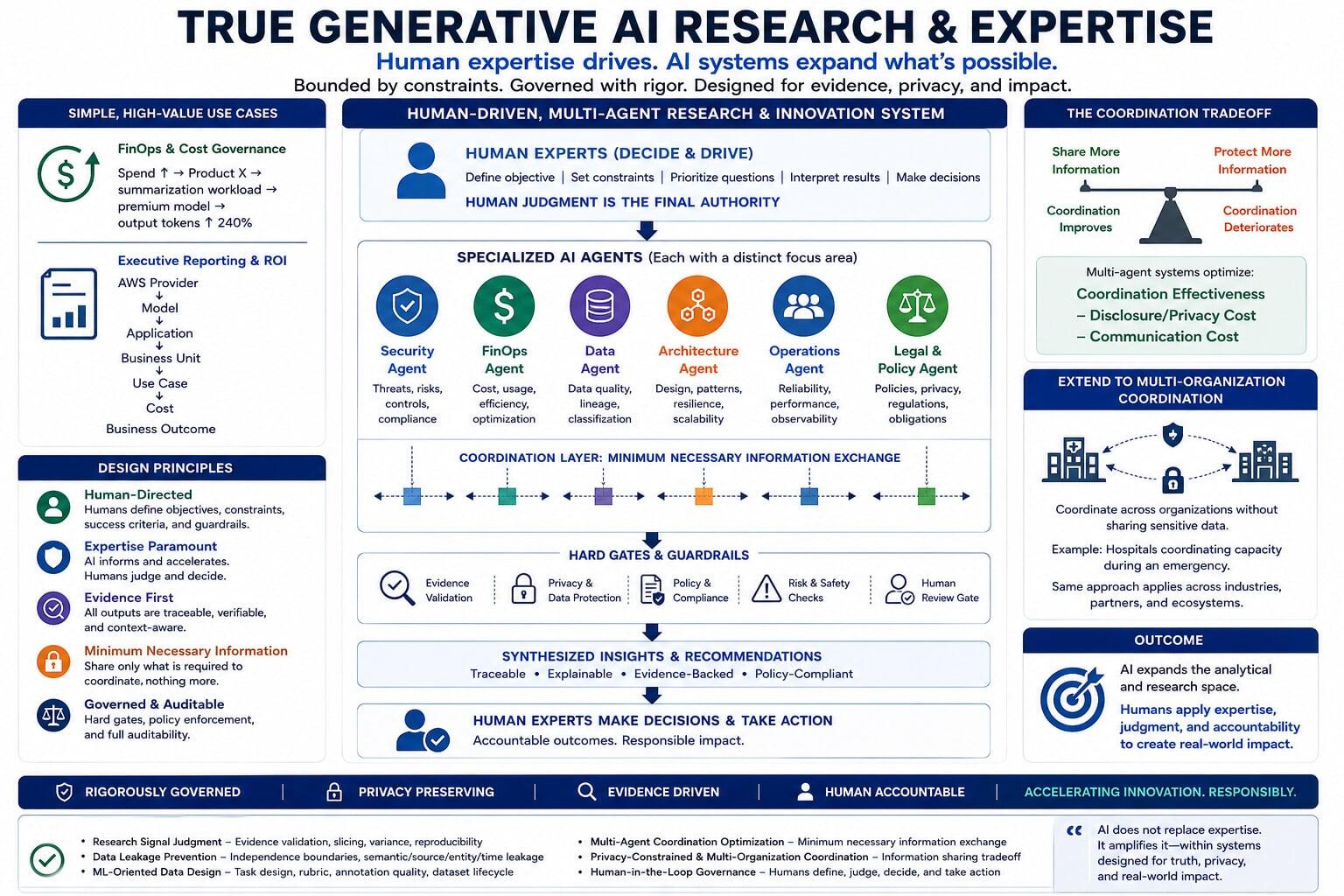
At the simpler end, AI can significantly improve existing processes. In FinOps, for example:
Spend ↑ → Product X → summarization workload → premium model → output tokens ↑ 240%
Or executive reporting can connect:
Provider → Model → Application → Business Unit → Use Case → Cost → Business Outcome
The more interesting opportunity, though, is not simple task automation but rather system engineering that helps experts investigate the problems that humans struggle to solve at scale.
Most systems implicitly force a tradeoff:
share more information → better coordination, greater exposure
or
protect more information → less exposure, more operational silos
But imagine multiple specialized agents examining the same problem from different perspectives, challenging one another’s conclusions, and exchanging only the minimum information necessary to coordinate while being constrained to hard evidence and defined gates. Extend that across organizations that cannot freely share information, such as hospitals coordinating capacity during an emergency.
The objective, constraints, judgment, and final decisions remain human, including whether there is sufficient evidence and what matters most. But AI expands both the speed and scope of what experts can investigate and evaluate. That is where Generative AI moves from content generation or task automation to human-directed systems for accelerating genuine research, innovation, and complex problem-solving.